

Birds, Not Mosquitoes (BNM), the multi-agency partnership that has been releasing millions of bacteria-infected mosquitoes on Maui and Kaua‘i, has just announced on social media that their open-air experiment is being paused because it has failed to accomplish its stated purpose.

The update found on BNM’s website states:
“As of March 2026, Birds, Not Mosquitoes (BNM) has paused its use of the Incompatible Insect Technique (IIT) in Hawaiʻi. This decision was made after extensive review of scientific data collected over the project’s three-year lifespan, which showed this one tool was not suppressing the mosquito populations enough to keep the birds safe.”
That data has still not been released to the public, and not only have these lab-altered mosquitoes proven to be ineffective, but there has been no indication that safety is even being evaluated. BNM has put the health of these islands at risk, and this failed experiment exposes the recklessness of these agencies and their escalating biotech agenda in Hawai‘i.
Hawai‘i Unites asserted in our court case that these Wolbachia-bacteria-infected southern house mosquitoes have not been sufficiently studied and could cause irreversible harm to the islands’ people, wildlife, and ‘āina. We took our case all the way up to the State Supreme Court, but ultimately, the state courts sided with state agencies, allowing for the continued exploitation of sacred lands as testing grounds. Now the mosquito release agencies are admitting that this was an experiment all along and that the data is still being analyzed. It could be years before we know the full ramifications of this travesty.
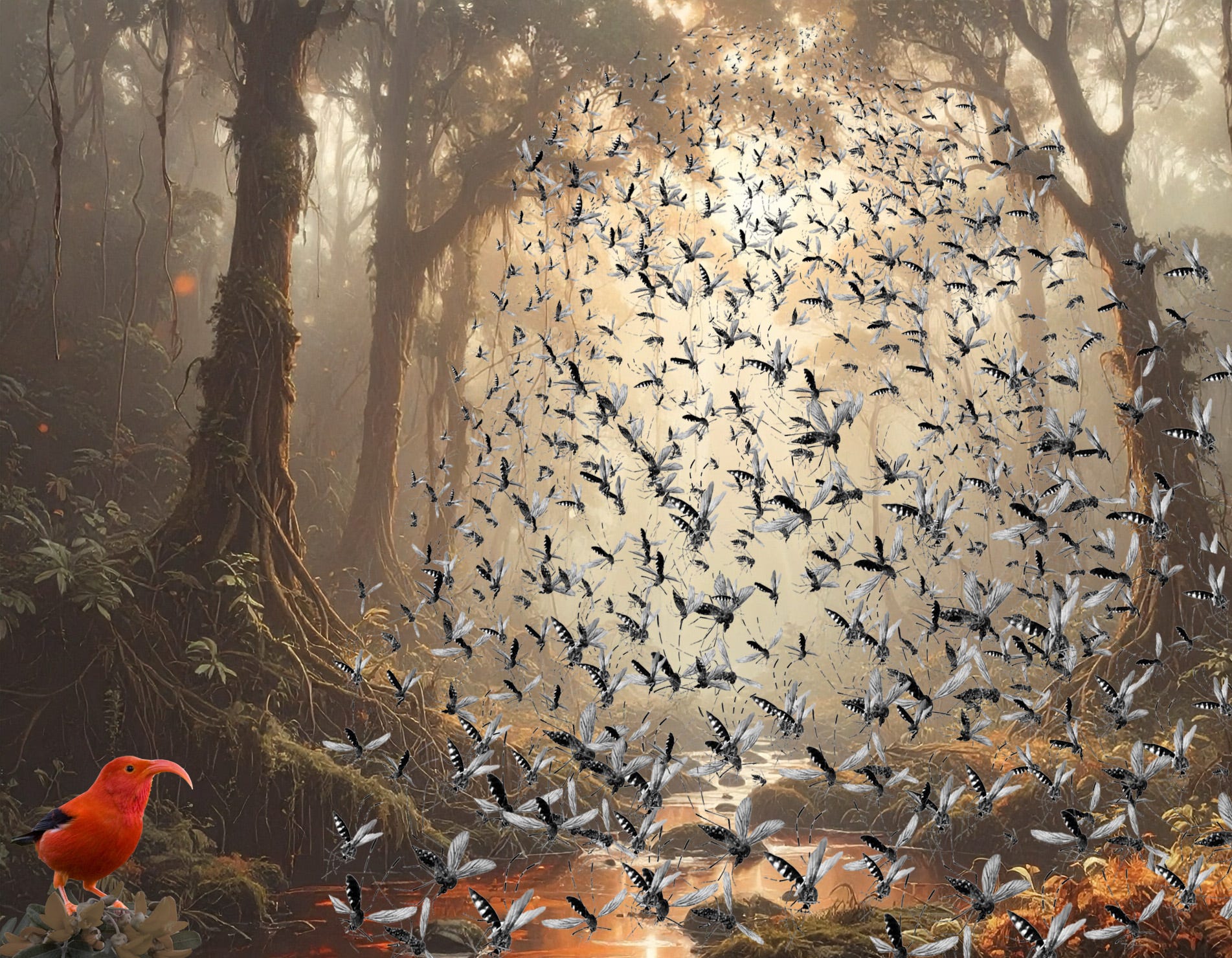
BNM’s website update confirms that their conservation efforts have been an experimental deployment of this mosquito technology. What they don’t acknowledge is that the species of lab-altered mosquito (Culex quinquefasciatus) had never been used before in a stand-alone field release prior to being unleashed in Hawai‘i and that peer-reviewed studies have shown Wolbachia bacteria to cause increased pathogen infection and disease transmitting capability in mosquitoes.
Rather than this colossal failure humbling these agencies, they’re now digging their heels in and setting the stage for their next experiment.
“As we work to protect Hawaiʻi’s precious manu from introduced avian malaria, our focus is now exploring alternative tools that are currently available as well as advancing future solutions that can operate effectively across our landscapes.
While this is not the outcome we had hoped for, it is an important part of the scientific process and an opportunity for further research and refinement.”
“In laboratory trials on the southern house mosquito, the technique showed promise. But translating those results from controlled environments into Hawaiʻi’s complex montane forests has proven much more challenging.”
“Developing, testing, and deploying this new conservation application was a necessary step toward giving our forest birds a fighting chance.”
“Science is an iterative and evolving process where what we learn informs our next steps. It’s important that we carefully analyze our results, including the challenges, to better apply IIT and other mosquito suppression techniques while we fight to save our native forest birds. While we wish conservation IIT had been a ‘slam dunk’, it’s unsurprising that there are complex environmental factors at play that need to be better understood for the technique to be more effective.
To clarify, we are pausing, not abandoning, conservation IIT. Our commitment to data-driven science means that we will continue to investigate and innovate toward making conservation IIT an even more effective tool for addressing mosquito-spread disease.”
“Our efforts also includes looking into future innovations as the science evolves.”
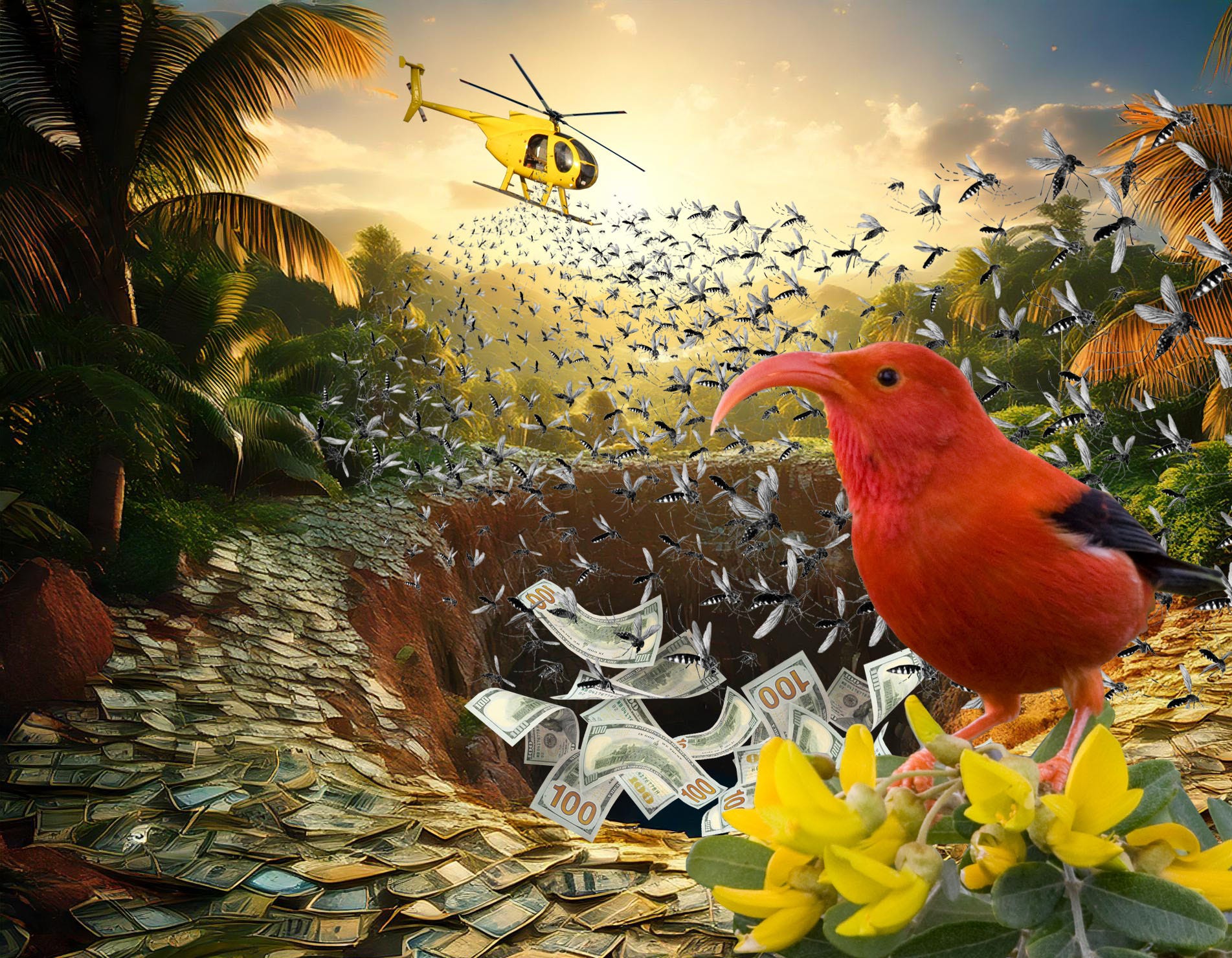
According to BNM agency documents, those future innovations would expand the mosquito release programs to include “next-generation tools” such as mosquito gene drives and precision-guided Sterile Insect Technique (pgSIT) CRISPR gene-edited mosquitoes, along with the production of mosquitoes in the DLNR’s Hawai‘i lab and release of mosquitoes on the islands “into perpetuity” (forever). This escalating agenda poses risks of unexpected genetic alterations and off-target effects and mutations, and these novel technologies could even wipe out entire species.
After being lied to about the experimental aspects of these mosquito releases for the past several years, why would our communities ever trust these agencies in the future? The true story of their actions will be their legacy.
What Birds, Not Mosquitoes has accomplished:
Releasing a dangerous open-air experiment into our environment
Pushing a propaganda campaign and lying to the people of these islands
Suppressing scientific discourse
Furthering distrust in government
Selling out the islands as biotech industry testing grounds
Risking the health of our environment, people, and wildlife
Undermining our environmental laws
What Birds, Not Mosquitoes has FAILED to accomplish:
Saving threatened and endangered native birds
Suppressing mosquito populations
Reducing avian malaria
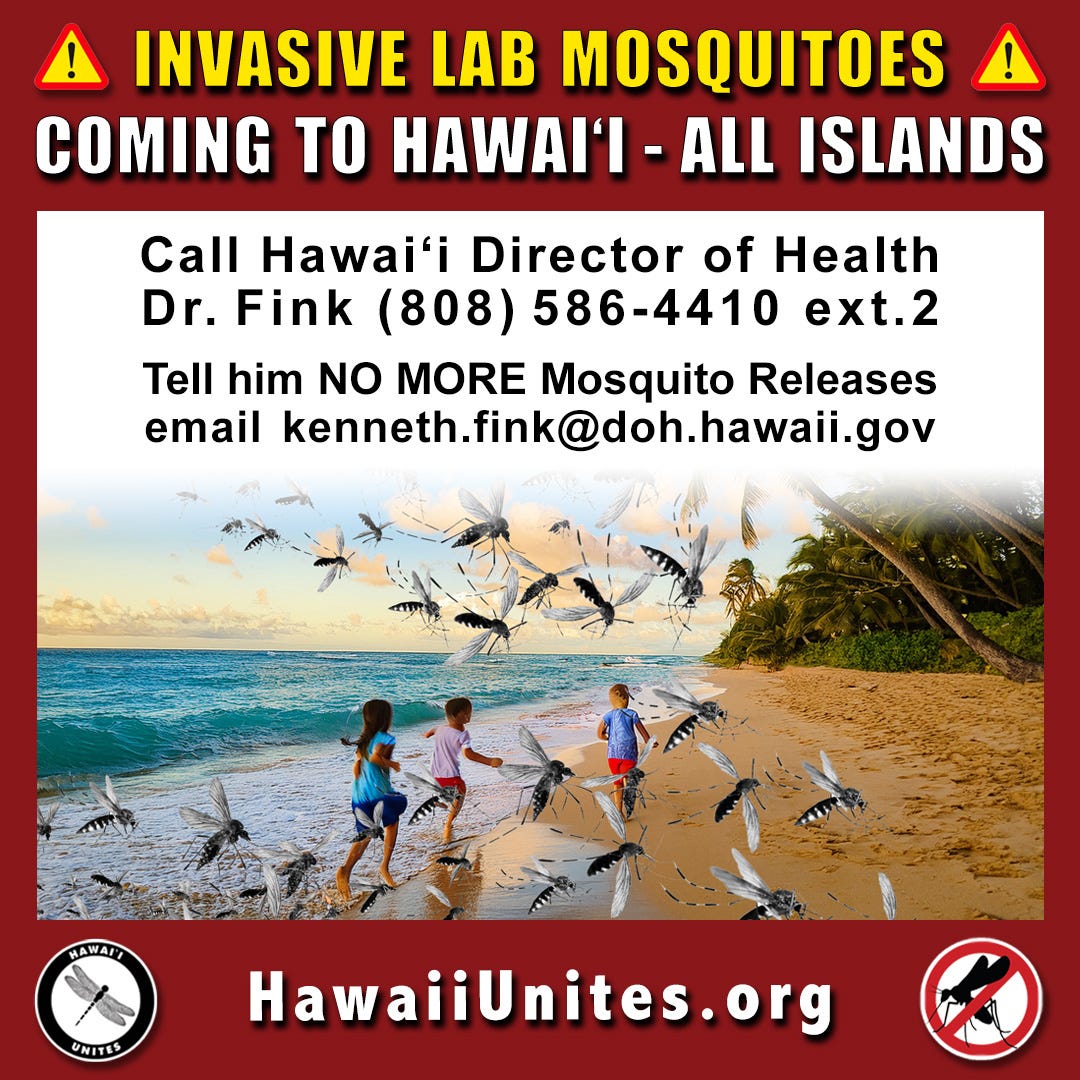
As Hawai‘i Unites previously reported, the State of Hawai‘i Department of Health (HDOH) intends to expand their BNM multi-agency mosquito release programs in Hawai’i to all of the islands, releasing three species of lab-altered mosquitoes and escalating the narrative from bird conservation to public health. If this plan moves forward, invasive lab mosquitoes would be released directly in our neighborhoods. The HDOH has not yet published their statewide proposal. We are watching for updates as we continue to push back against this planned expansion.
Please help make our voices heard and continue to contact HDOH Director of Health Dr. Kenneth Fink by phone and email to let him know that you don’t want any more of these mosquito releases in Hawai‘i.
Dr. Kenneth Fink
(808) 586-4410 ext.2
(leave a voicemail if prompted)
kenneth.fink@doh.hawaii.gov
Mahalo for standing together with us to oppose these dangerous, irreversible experiments.
Aloha,
Tina Lia
Founder
Hawai‘i Unites
HawaiiUnites.org
Hawai‘i Unites is a 501(c)(3) nonprofit organization dedicated to the conservation and protection of our environment and natural resources. Your tax-deductible donations help us to fulfill our mission of honoring and protecting our sacred connection to the natural world.

Report a Mosquito Bite
The State of Hawai‘i and its multi-agency partnership Birds, Not Mosquitoes have been releasing bacteria-infected mosquitoes in East Maui and conducting pilot study releases on Kaua‘i since 2023. As part of our ongoing research and documentation, Hawai‘i Unites has been compiling reports from throughout the islands about unusual mosquito bite reactions. If you’ve been bitten by a mosquito and would like to report the incident, please complete our Mosquito Bite Incident Report.