

Mahalo (thank you) to Jimmy Dore for covering this important topic and helping to raise awareness about the dangers of releasing insufficiently studied lab-altered mosquito and tick technologies into our environment. Please watch and share this recent interview where we discuss the biotech industry’s targeting of our communities as testing grounds for open-air experiments:
“Jimmy Dore interviews Tina Lia, founder of Hawaii Unites, about concerns over the release of lab-altered, Wolbachia-infected mosquitoes in Hawaii and proposed deployments in California and Florida. Lia says that regulators have not adequately studied potential environmental and human-health risks, disclosed sufficient safety data, or addressed concerns about unintended releases of female mosquitoes and the possible spread of bacteria to wild insect populations.
The two also criticize the financial relationships between government agencies, biotech companies, and research institutions, highlighting Google’s involvement in the Debug mosquito program and a federal executive order promoting insect-control technologies. Overall, they call for greater transparency, independent research, public consent, and broader opposition to experimental insect-release programs, while presenting their concerns and allegations as reasons for increased scrutiny.”
As we reported last month, on the same day of the White House tech summit with Google CEO Sundar Pichai and other tech executives, a new executive order was signed to push lab-altered mosquito and tick technology into our environment. Google operates the Debug Project, breeding and releasing lab-altered mosquitoes, including the experimental bacteria-infected DQB Strain Culex mosquitoes being released in Hawai‘i and planned for release in California and Florida.
The Order states that “it is the policy of the United States to develop and deploy commonsense approaches and technological capabilities to suppress tick and mosquito populations and address the harms these insects cause…” and that implementation includes plans to “prioritize and expeditiously advance or register novel tick and mosquito control methods or products that the Administrator of the Environmental Protection Agency finds to be both safe and effective.”
The Executive Order can be read in full on the White House website:
Our experience here in Hawai‘i has shown that the EPA is not sufficiently studying these lab-altered arthropod products, and that they are not being proven “safe and effective” by the EPA prior to approval. Serious concerns about risks to our environment, animals, and human health are not being adequately addressed, calling into question the integrity of the entire regulatory process for mosquito and tick biopesticides.
We need a larger coalition to push back against this reckless agenda. Hawai‘i Unites is asking that more people and organizations speak out and join us in this fight and that attorneys step up who can help us take this on at the federal level. Releasing lab-altered disease vectors is not making America healthy. Please share this information with your network and help us build a strong alliance of voices to put a stop to this open-air biotech experimentation in our environment.
Thank you to everyone who sent in comments to the EPA on Google’s Experimental Use Permit Application to release 64 million experimental DQB Strain Culex mosquitoes in California and Florida (comment period now closed). The docket is showing 2,730 comments published, and we are continuing to follow the status of this application as we await the EPA’s response to our concerns.
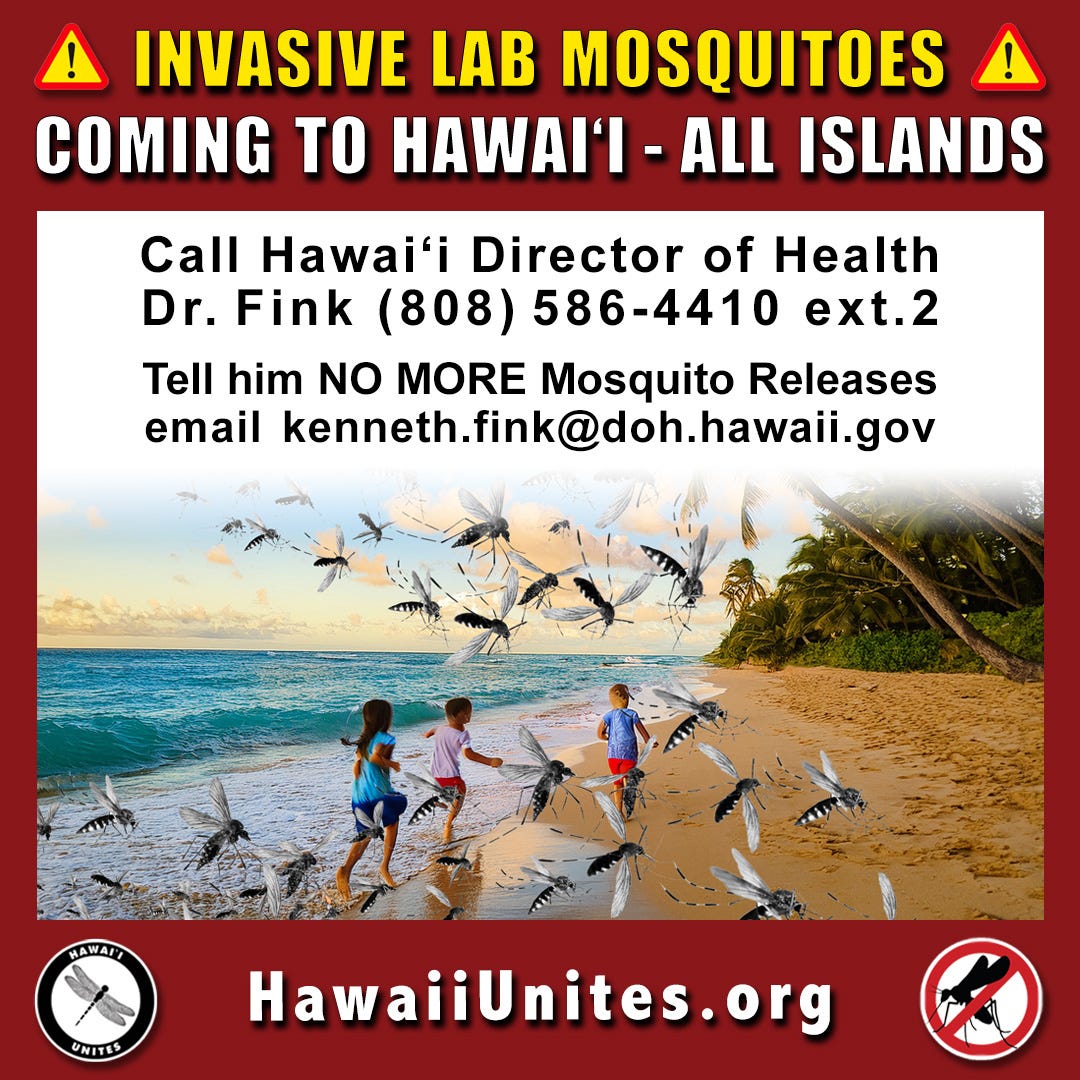
As Hawai‘i Unites previously reported, the State of Hawai‘i Department of Health (HDOH) intends to expand their multi-agency mosquito release programs in Hawai’i to all of the islands, releasing three species of lab-altered mosquitoes and escalating the narrative from bird conservation to public health. If this plan moves forward, invasive lab mosquitoes would be released directly in our neighborhoods. The HDOH’s mosquito release partners have stated their intention to continue expanding the mosquito release programs to include “next-generation tools” such as mosquito gene drives and precision-guided Sterile Insect Technique (pgSIT) CRISPR gene-edited mosquitoes, along with the production of mosquitoes in the DLNR’s Hawai‘i lab and release of mosquitoes on the islands “into perpetuity” (forever).
So far, the HDOH appears to be holding off on publishing their statewide proposal. It’s important that we continue making our voices heard in strong opposition to the planned expansion of these mosquito releases. Please continue to contact HDOH Director of Health Dr. Kenneth Fink by phone and email to let him know that you don’t want any more of these mosquito releases in Hawai‘i.
Dr. Kenneth Fink
(808) 586-4410 ext.2
(leave a voicemail if prompted)
kenneth.fink@doh.hawaii.gov
Mahalo for standing with us to protect our health and our environment from these dangerous, irreversible experiments.
Aloha,
Tina Lia
Founder
Hawai‘i Unites
HawaiiUnites.org
Hawai‘i Unites is a 501(c)(3) nonprofit organization dedicated to the conservation and protection of our environment and natural resources. Your tax-deductible donations help us to fulfill our mission of honoring and protecting our sacred connection to the natural world.

Report a Mosquito Bite
The State of Hawai‘i and its multi-agency partnership Birds, Not Mosquitoes have been releasing bacteria-infected mosquitoes in East Maui and conducting pilot study releases on Kaua‘i since 2023. As part of our ongoing research and documentation, Hawai‘i Unites has been compiling reports from throughout the islands about unusual mosquito bite reactions. If you’ve been bitten by a mosquito and would like to report the incident, please complete our Mosquito Bite Incident Report.
Fantabulous Dore segment big time kudos & thanks for the research, reporting & resistance!!
Mahalo Hawai'i <3
Excellent interview! Glad to see this important topic is getting more press. To emphasize what Tina is explaining, male mosquitoes are still a major biosecurity risk since they can pass pathogens onto biting females thru mating and it is well known that Wolbachia acts as a gene drive with unknown side effects to host and environment.